Sydney, Melbourne, Sydney · 1939
Anna May Wong
in Australia
Hollywood’s first Chinese American star came to Australia in 1939 and topped the bill at the Tivoli, in Melbourne and then in Sydney, as the country went towards war. Here is her visit day by day, from the newspapers that followed her, and the book that first told it.
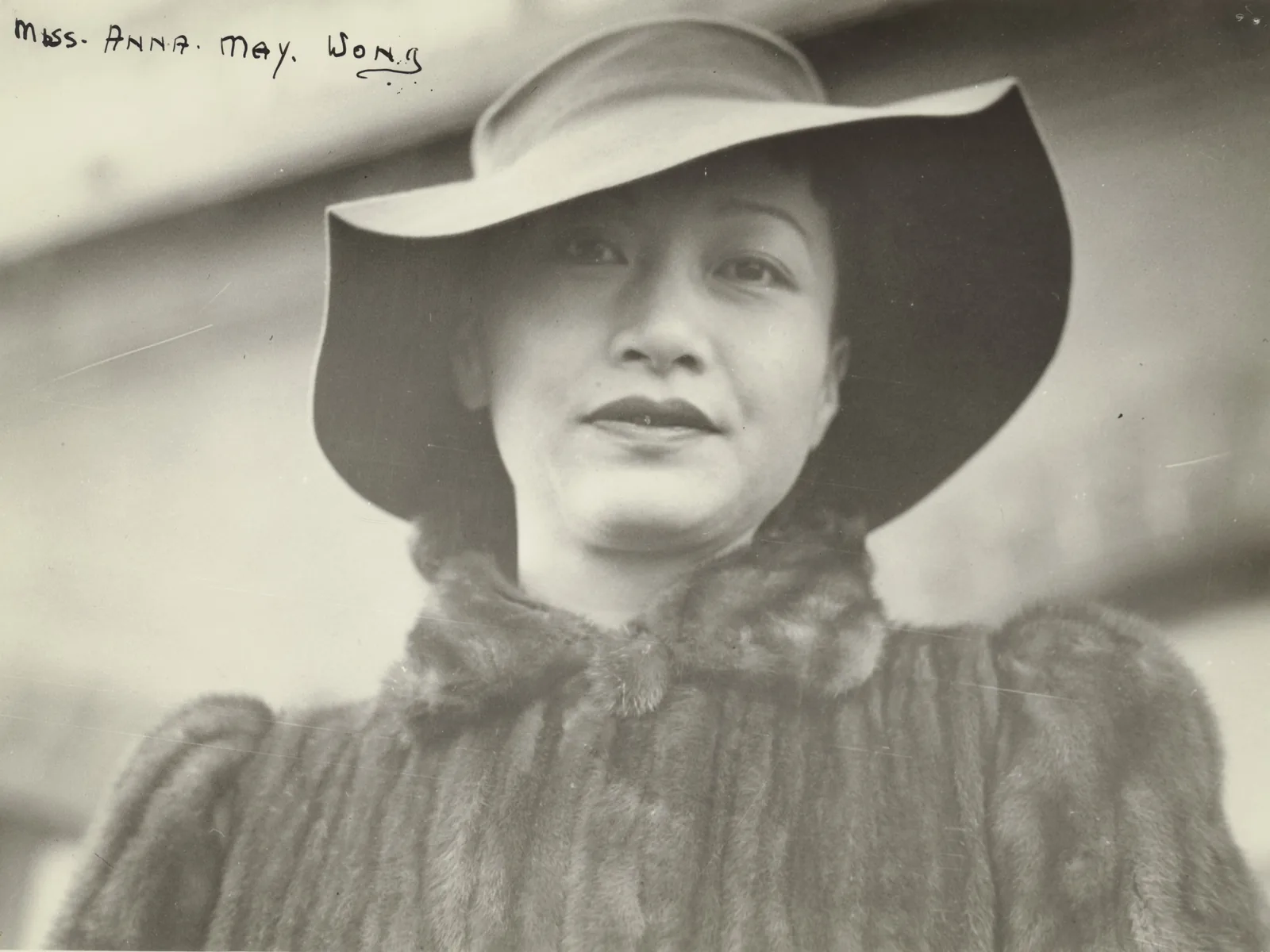
Who she was
She was born in Los Angeles, a laundryman’s daughter, and was in films at fourteen and a star at seventeen. Hollywood then spent fifteen years casting her as the slave girl, the vamp and the villain, usually one who died. In 1928 she left for Berlin and London, where she was a leading lady, and came back to the same parts.
By 1939 she had turned down The Good Earth, been to China, and was making B-pictures at Paramount. Frank Neil of the Tivoli circuit had been trying to bring her to Australia since 1934. By April she had said yes.
- 1905Born Wong Liu Tsong, 黃柳霜, “frosted yellow willow”, at 351 South Flower Street, Los Angeles, on 3 January, the daughter of a laundryman.
- 1919An extra carrying a lantern in Nazimova’s The Red Lantern, at fourteen.
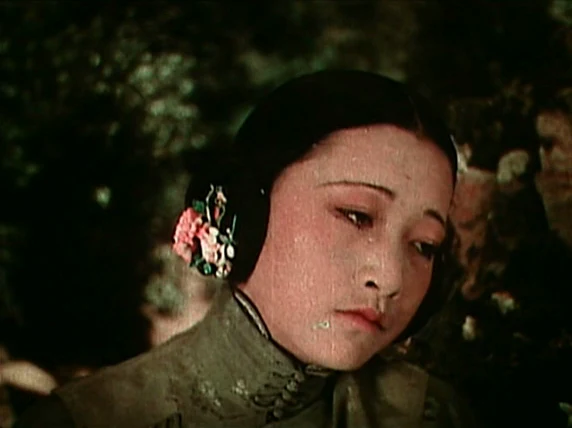
- 1922The lead in The Toll of the Sea, shot in two-colour Technicolor. She was seventeen.
- 1924The Mongol slave in Douglas Fairbanks’s The Thief of Bagdad, and Tiger Lily in Peter Pan.
- 1928Leaves Hollywood for Berlin and London: “I think I left America because I died so often.”
- 1929Piccadilly, in London, and The Circle of Chalk on the London stage, with Laurence Olivier and the Melbourne-born Rose Quong.
- 1932Hui Fei in Shanghai Express, with Marlene Dietrich.
- 1934Voted the world’s best-dressed woman by the Mayfair Mannequin Society of New York.
- 1935Asks MGM to let her play O-lan, the heroine of The Good Earth. Offered “the only unsympathetic role in the picture”, she turns it down.
- 1936Ten months in China, her first visit.
- 1939Paramount B-pictures: King of Chinatown and Island of Lost Men. On 4 May she sails for Australia.
- 1942Bombs Over Burma and Lady from Chungking; she gives both salaries to United China Relief.
- 1951The Gallery of Madame Liu-Tsong, the first American television series with an Asian American lead. No copy survives.
- 1961Dies at home in Santa Monica on Friday 3 February, aged 56.

to
76 days in Australia
Frank Neil, who ran the Tivoli circuit, had been trying to bring her out since 1934. In March 1939 he announced he had her: Melbourne in June, Sydney in July. To the Sydney Morning Herald’s man in Hollywood she said she was tired of being looked at “as a freak — something akin to a five-legged dog or a two-headed calf”.
She was ashore for seventy-six days, from Sunday 4 June to Friday 18 August 1939: five weeks at the top of the bill at the Tivoli in Melbourne, four in Sydney, and between the shows a life the papers followed day by day. These are the days they wrote about.
The crossing out
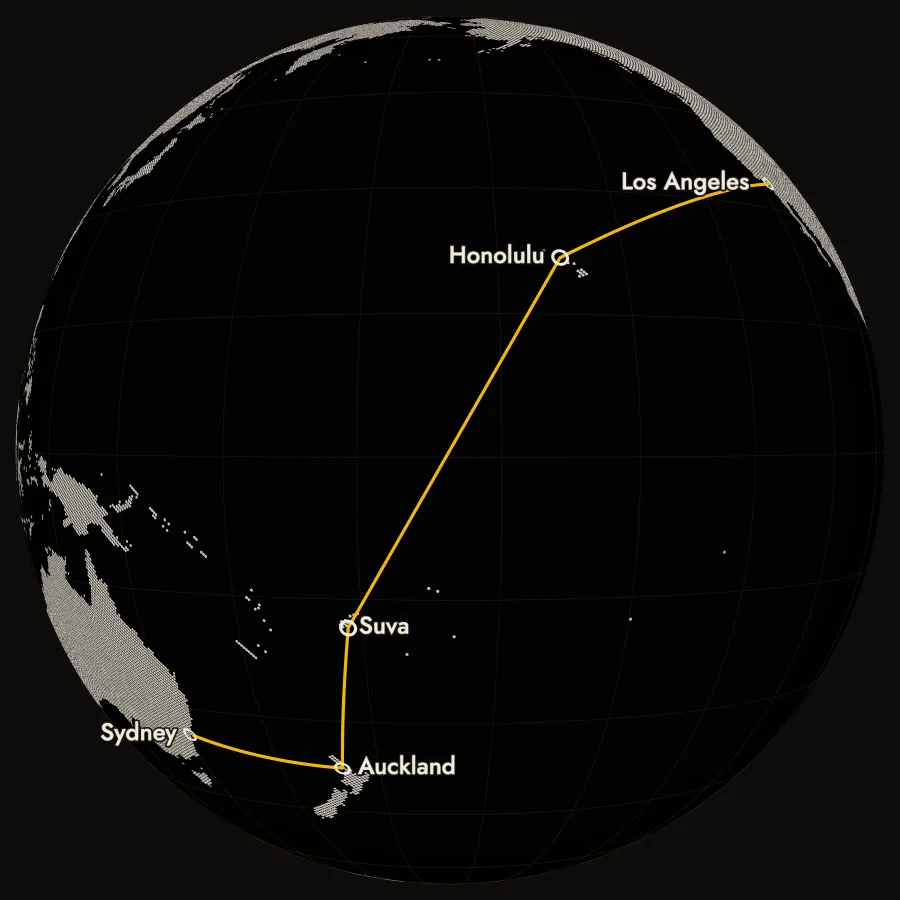
On 4 May she sailed from San Pedro, the port of Los Angeles, in the Matson liner Matsonia. After a holiday in Honolulu she joined the Canadian-Australasian liner Aorangi there on 17 May, with fourteen American variety acts for the same Tivoli show. Bad weather put the ship a day behind, and she reached Sydney on Sunday morning, 4 June.
- Los Angeles
- Honolulu
- Suva
- Auckland
- Sydney
Before
Los Angeles
Permission to come home
She was an American, born in Los Angeles. But under the Chinese Exclusion laws an American “of the Chinese race” who meant to travel had to prove her citizenship before she went, or risk not being let back in. On 6 April she swore to an immigration inspector that she was born at 351 South Flower Street on 3 January 1905, that she was “with Paramount Pictures”, and that she would sail “From San Pedro on the ‘Matsonia’ May 4, 1939”. The form was approved a week later.
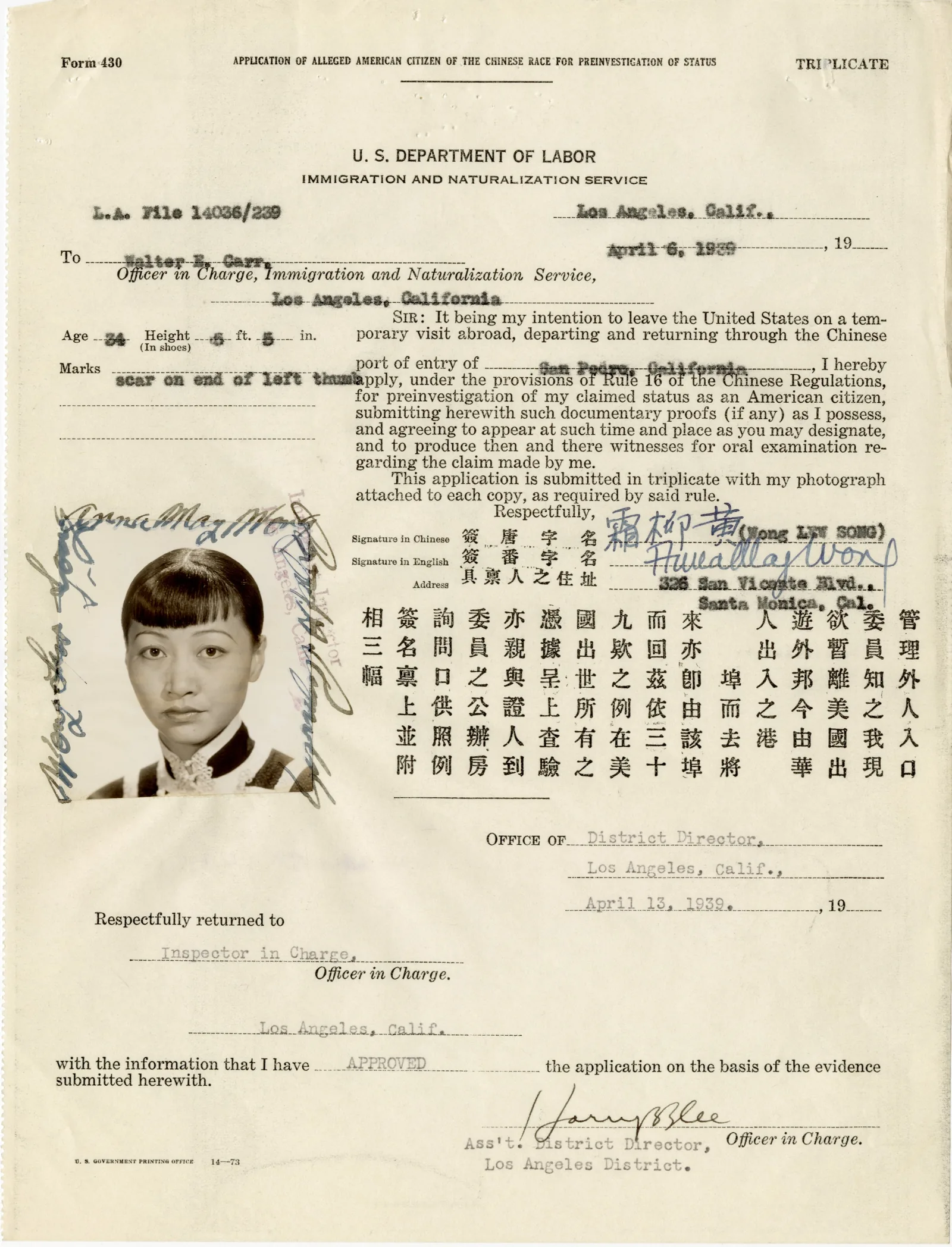
To leave the country she was born in and be let back in, an American “of the Chinese race” had to apply in advance. Her Form 430, dated 6 April 1939: her photograph, “Height 5 ft. 5 in.”, “Marks: scar on end of left thumb”, and her name signed in English and Chinese. US National Archives, Chinese Exclusion Act case file 14036/239 From US National Archives, case file 14036/239 and US National Archives, case file 14036/236-A.
Before
Hollywood
“Those big countries down under”
On a Paramount set she told Lon Jones, the Sydney Morning Herald’s man in Hollywood, why she was going.
“I want to see those big countries ‘down under’ because I’ve met so many people who rave about Australia and New Zealand, and I feel there must be something to those raves.”
“I want to be an actress, not a freak. I want to feel that people go to see my pictures because I perform well, not just because I am an Oriental.”
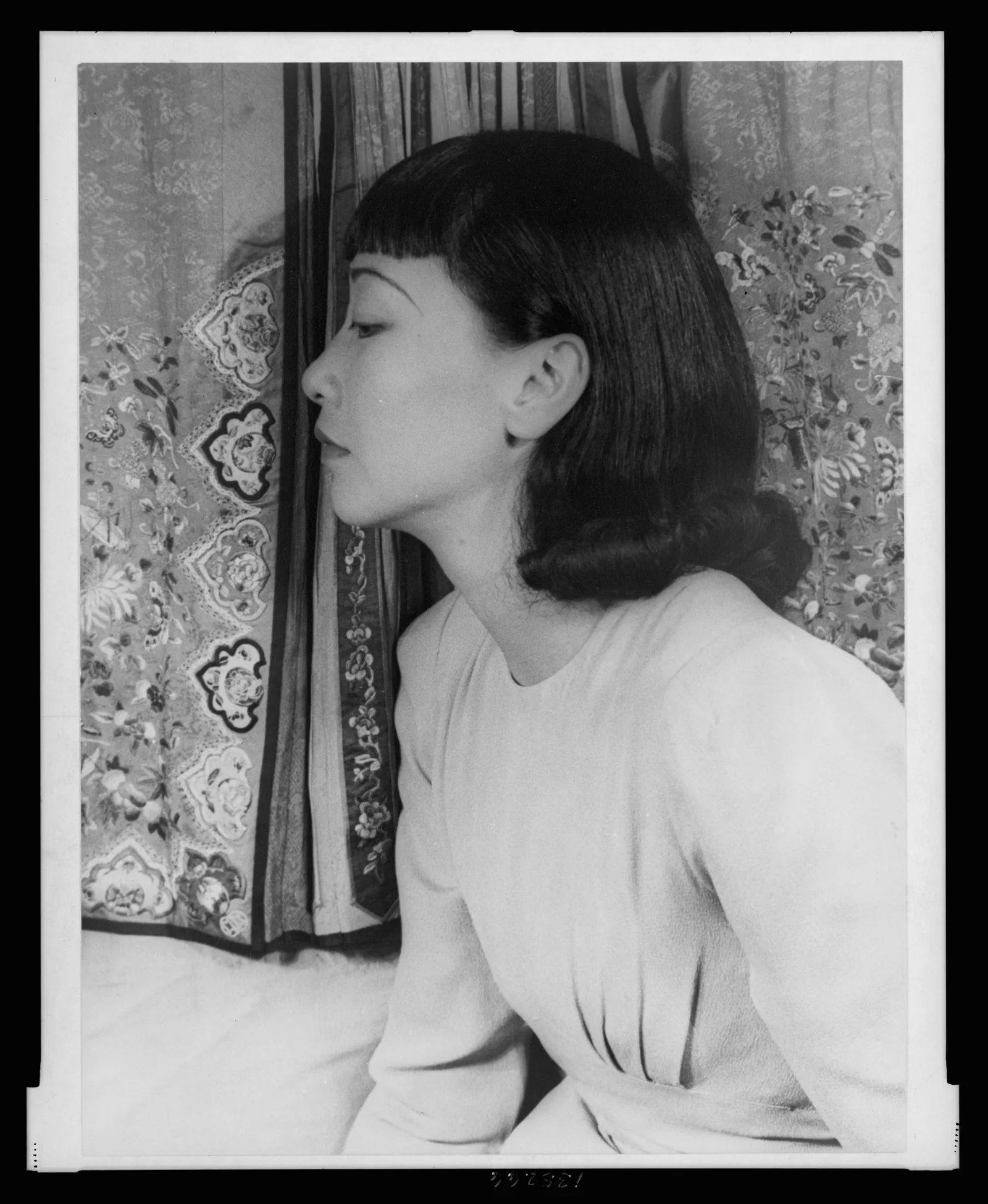
Carl Van Vechten photographed her on 25 April 1939, nine days before she sailed. Carl Van Vechten, Library of Congress From The Telegraph, Brisbane, 29 April 1939, p. 22 and The Sydney Morning Herald, 1 May 1939, p. 8.
At sea
At sea, Auckland
Chickenpox, and a day late
She had joined the Canadian-Australasian liner Aorangi at Honolulu on 17 May, with fourteen American acts for the same Tivoli bill. The ship reached Auckland with five passengers recovering from chickenpox, and bad weather after Suva had put her a day behind: Sydney on Sunday, not Saturday. The Consul-General for China, Dr C. J. Pao, and Madame Pao called off the welcome they had planned for her at Point Piper.
From The Herald, Melbourne, 20 May 1939, p. 20, The Sydney Morning Herald, 30 May 1939, p. 11 and The Sydney Morning Herald, 30 May 1939, p. 16.
1
Day of 76
Sydney
Arrives in the Aorangi
She landed on Sunday morning at No. 5 Darling Harbour. Dr and Madame Pao and many of Sydney’s Chinese community met the ship, and the Consul-General’s secretary, Mrs L. Young, greeted her on board. Babe Didrikson and the Vienna Mozart Boys’ Choir came off the same ship. Cinesound and Fox Movietone filmed her coming down the gangway in her fur coat; Fox’s 47 seconds, in which she thanks the Paos, are at the National Film and Sound Archive.
She called on Dr Pao that afternoon and took the Melbourne express that night.
“Let’s get this straight. According to rumor, I’ve been born in every place in the world. I have become tired of contradicting. I paid my first visit to China in 1936. Everybody thought I had gone there to get myself a husband.”
“China is essentially a man’s country, where everything, laws and customs, are for men. After years of independence, I could not bow to restraint.”
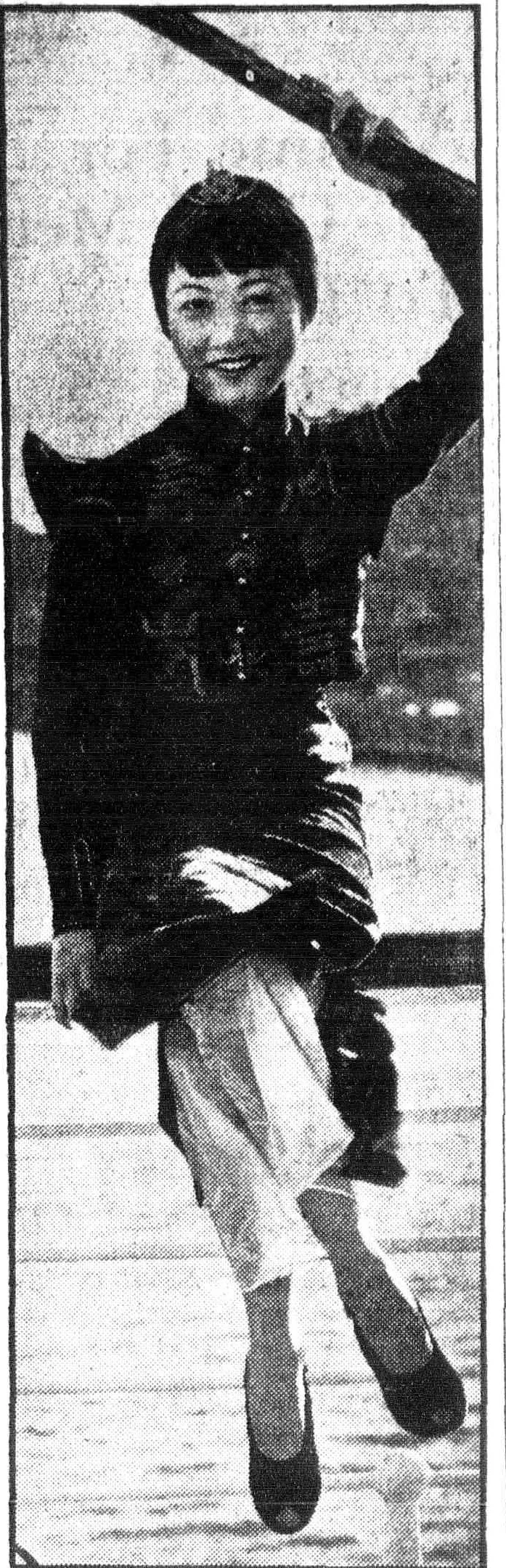
On the rail of the Aorangi: “ANNA MAY WONG, Chinese film star, who arrived yesterday by the Aorangi.” The Daily Telegraph, Sydney, 5 June 1939, p. 5 From The Daily Telegraph, 5 June 1939, p. 10, The Daily Telegraph, 5 June 1939, p. 10, Daily News, Sydney, 5 June 1939, p. 2 and Fox Movietone News, National Film and Sound Archive.
1
Day of 76
Sydney Harbour
A spy on the Aorangi
Revealed in 1945: a detective working with Military Intelligence went aboard with the Cinesound cameraman who had come for pictures of her. Off Garden Island he saw a Japanese passenger photographing the warships with a telephoto Leica, and had the cameraman film him doing it. By that account it was Military Intelligence’s first contact with Japanese espionage in Australia, three months before the war.
2
Day of 76
Melbourne
Spencer Street, then Bourke Street
The Spirit of Progress brought her into Spencer Street at 11.30 with her pianist, Merrill La Fontaine. At midday hundreds met her in the Tivoli’s vestibule, the lunch-hour crowd filled Bourke Street, and 3KZ broadcast an interview twice. The Age began with Melbourne’s own Rose Quong, who had played with her in London ten years before.
“Actually I have been doing sinister roles for so long that I have got mental indigestion.”
“Playing in films and on the stage is my means of livelihood, and I take my work seriously. It has given me an opportunity to travel, has broadened my education and, above all, has brought me into contact with many very interesting people. I might have been just another girl in Hollywood.”
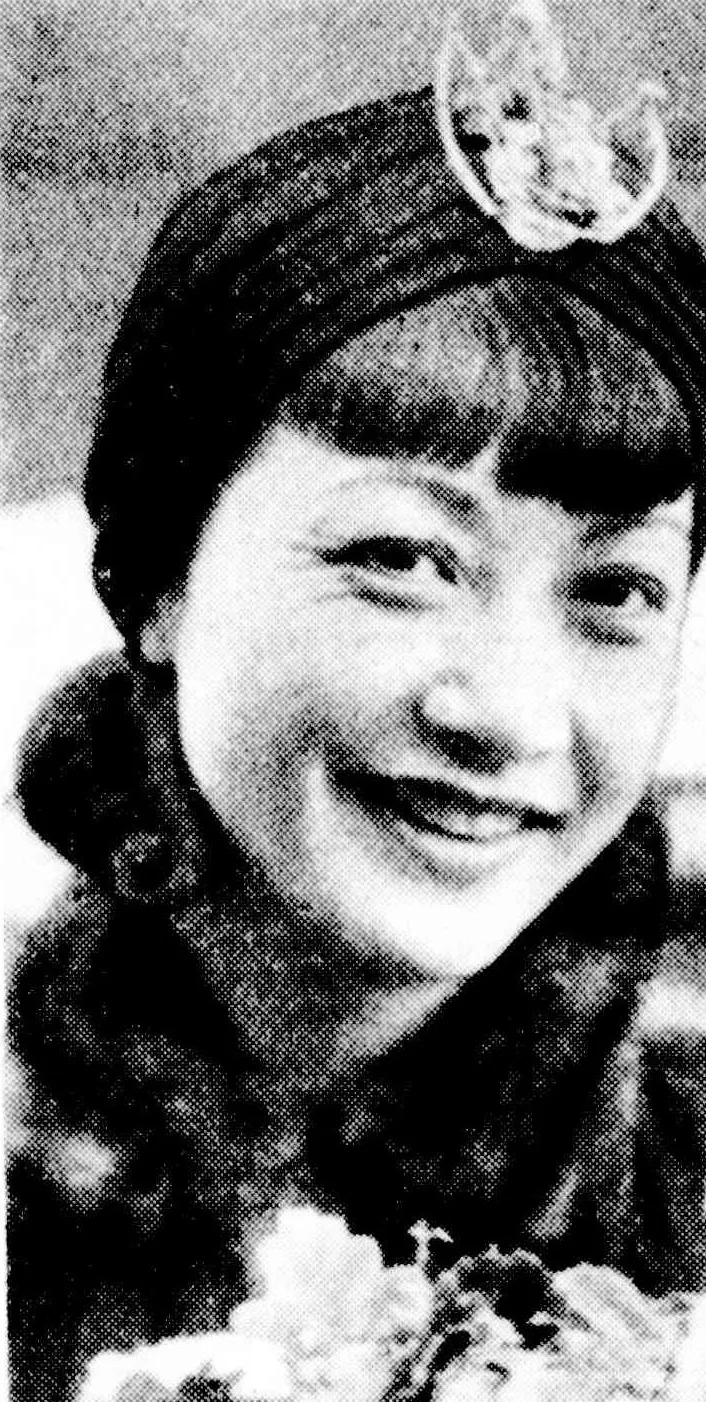
At Spencer Street station the next morning, on her arrival in Melbourne. The Age, 6 June 1939, p. 15 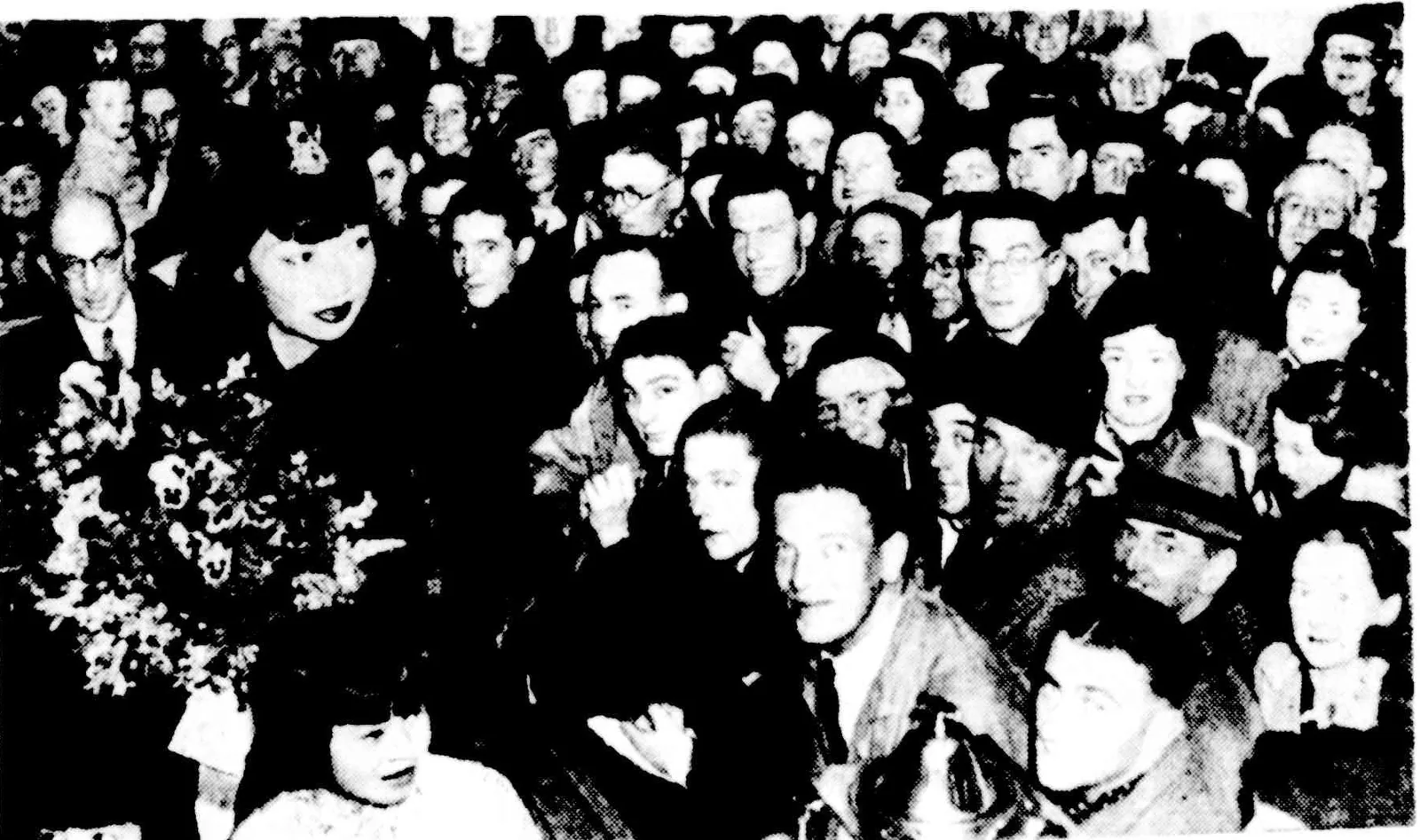
“Lunch hour crowds in Bourke street gave a rousing welcome to the famous film star when she arrived at the Tivoli Theatre yesterday.” Animated by AI from the photograph; the movement is ours, not the archive’s. The Argus, 6 June 1939, p. 5 From The Herald, 5 June 1939, p. 3, The Age, 6 June 1939, p. 8, The Argus, 6 June 1939, p. 4 and The Argus, 6 June 1939, p. 5.
3
Day of 76
Melbourne
Guest of honour at the Princess
At Lady Latham’s gala for the Children’s Hospital she sat in a stage box with Sir John and Lady Latham, the Lord Mayor and Larry Adler, and was given an ovation when she appeared.
“During the interval brunette met blonde when Anna May Wong and Mrs. Douglas Stephens lit one another’s cigarettes beside Mrs. J. B. Tait’s sweet stall. Anna May, who is taller than one expects, wore a long white ermine coat over a Chinese robe of cream satin.”
From The Argus, 7 June 1939, p. 15 and The Bulletin, 14 June 1939.
7
Day of 76
Melbourne
The Young Chinese League at Menzies’
Melbourne’s Chinese community gave her a reception and dance at Menzies’ Hotel, the Young Chinese League’s president, F. A. Chinn, in the chair. She wore orange crepe trimmed with jade green.
From The Herald, 10 June 1939, p. 7 and The Age, 12 June 1939, p. 3.
8
Day of 76
Melbourne
Firecrackers in the dressing-room
At rehearsals the company heard what sounded like a machine gun, and found her calmly watching a bundle of firecrackers go off in her dressing-room.
“I am chasing away the evil spirits.”
9
Day of 76
Melbourne
Highlights from Hollywood opens at the Tivoli
Frank Neil’s all-American bill opened on Monday 12 June, twice a day, with her at the top of it in the second half: a Chinese song, a French one, a send-up of “the Australian girl”, and Noël Coward’s “Half-Caste Woman”, in Chinese costume before a Chinese set. With her were Betty Burgess and Sonny Lamont, the Andrini Brothers, “Bugs” Wilson, who was the voice of Grumpy in Snow White, the Athrillos and the Tivoli Ballet. She had called her act “a pot-pourri of elocution, a little singing and perhaps a mad venture into dramatics”. Most critics were charmed. The Bulletin was not.
“Charming, talented and entertaining in the many screen roles in which she has appeared, Anna May Wong, the American-born Chinese film star, is equally attractive in vaudeville.”
“She sings songs in Chinese, in French and in English, but has no voice to speak of.”
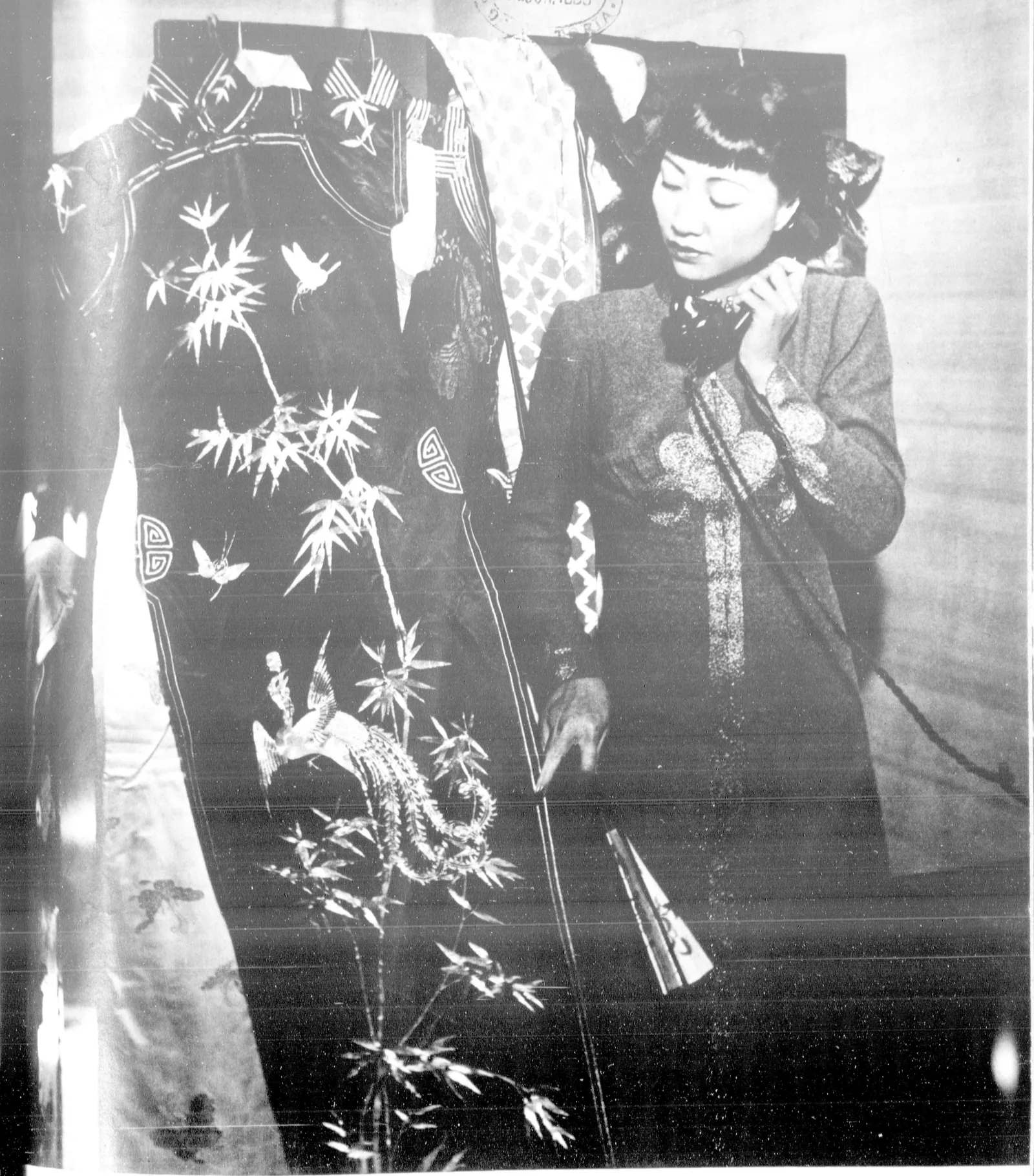
“Anna May Wong unpacks her wardrobe of National Chinese costumes which she wears in her stage appearance at the Tivoli Theatre and decides that her first job in Melbourne is to ring for help in pressing out the creases.” Table Talk, 15 June 1939, p. 3 From The Argus, 13 June 1939, p. 12, The Age, 13 June 1939, p. 10, The Herald, 13 June 1939, p. 21 and The Bulletin, 21 June 1939.
9
Day of 76
Melbourne
A tiny shoe in the dressing-room
That morning, at the last rehearsal before the first matinee, she showed The Sun News-Pictorial’s Jonathan Swift the shoe she kept as her mascot. It is the lucky shoe of the book’s title (below).
11
Day of 76
Melbourne
In person at the Capitol
Between Tivoli shows she appeared in person at the Capitol, where her new Paramount picture, King of Chinatown, was showing: “See her in the foyer.”
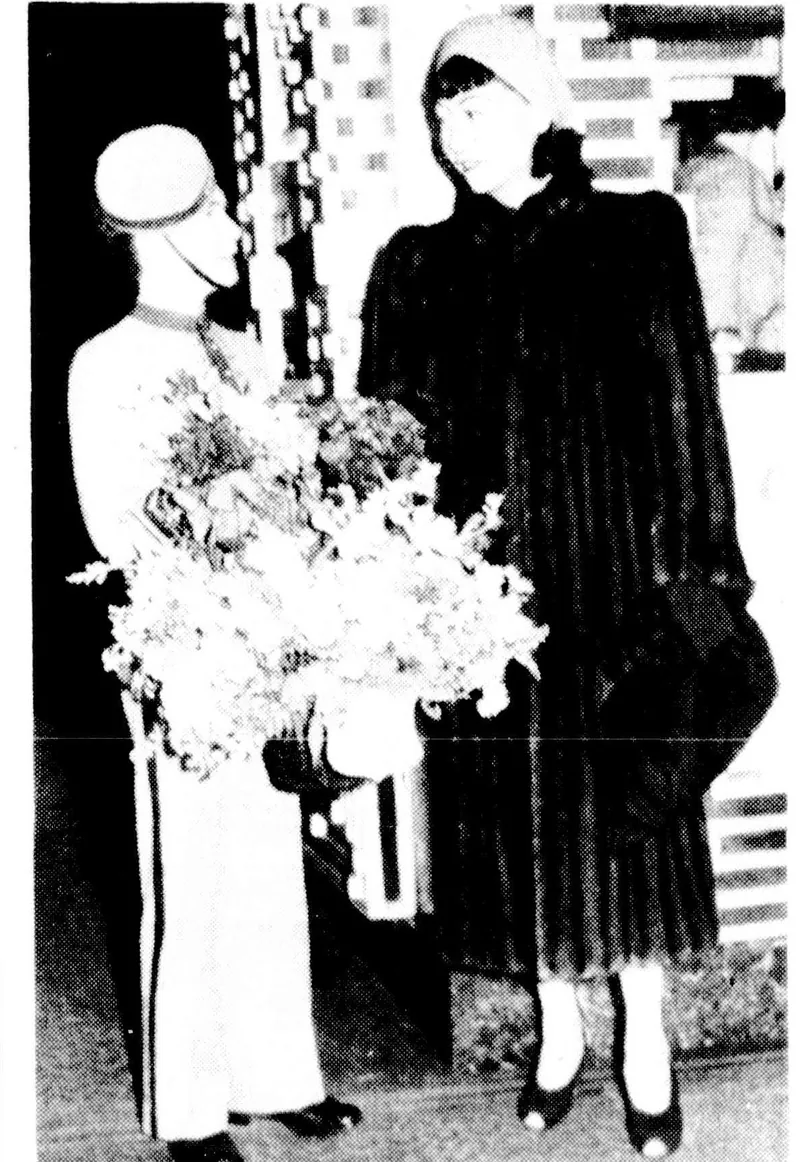
Taking a bouquet from a page boy at the Capitol, where King of Chinatown was showing. Animated by AI from the photograph; the movement is ours, not the archive’s. The Age, 15 June 1939, p. 15 From The Herald, 13 June 1939, p. 9, The Age, 15 June 1939, p. 15 and The Argus, 15 June 1939, p. 5.
12
Day of 76
Melbourne
Table Talk goes back-stage
Table Talk’s interviewer saw King of Chinatown, then met her in her dressing-room at the Tivoli.
“No — just plain ‘Anna Wong.’ When I took up screen work I added the ‘May’ because it sounded more euphonious — and, anyhow, it’s my favorite month, and having it in my name makes it seem as though it brings good luck to me.”
“There’s one very commendable point I’ve noted about all you Australian newspapermen: not one of you has asked me what I think of your country, and how I like being here.”
13
Day of 76
Melbourne
Lunch, and the shoe department at Foy’s
Foy’s advertised that she would lunch in its Radio Hall on Friday and then shop in its departments. The Argus caught her in the shoe department with a shoe in her lap: the only photograph of her with shoes in the Australian papers.
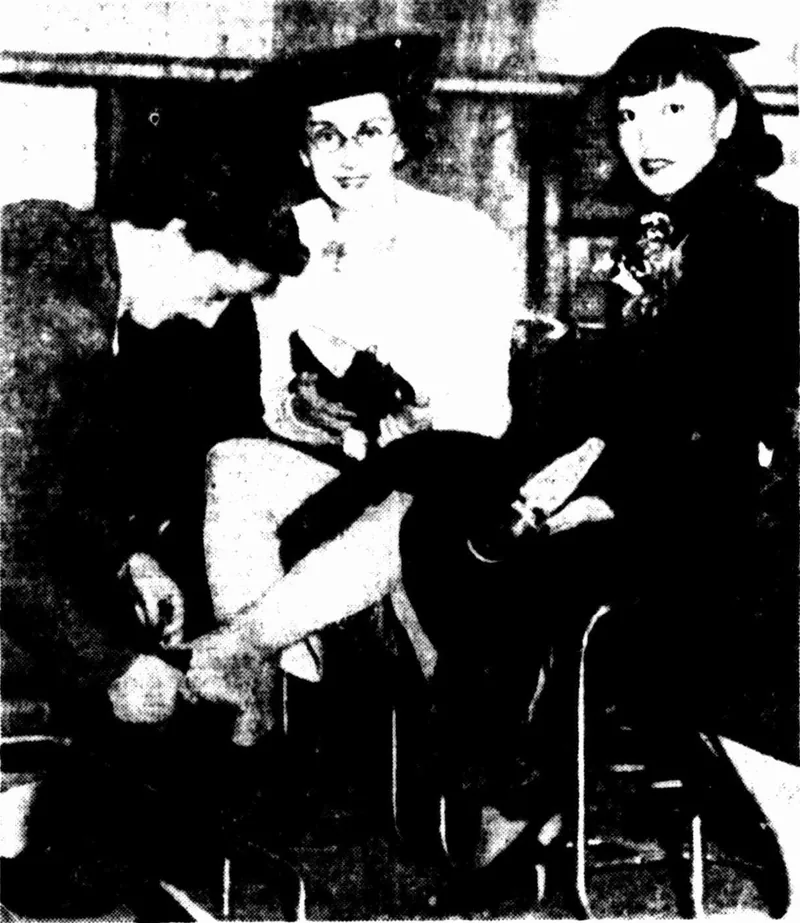
In the shoe department at Foy’s: “photographed while shopping at Foy’s Fashion Corner.” Animated by AI from the photograph; the movement is ours, not the archive’s. The Argus, 17 June 1939, p. 18 From The Herald, 15 June 1939, p. 38, The Argus, 17 June 1939, p. 18 and The Sun News-Pictorial, 17 June 1939, p. 16.
15
Day of 76
Healesville
A baby koala
On Sunday George Fitzwater of Neal’s Motors drove her to Healesville, her first sight of the bush, for the Grand Hotel and the Sir Colin MacKenzie Sanctuary. A month later she told a Sydney columnist she had no intention of paying “the traditional visit to see the koalas”.
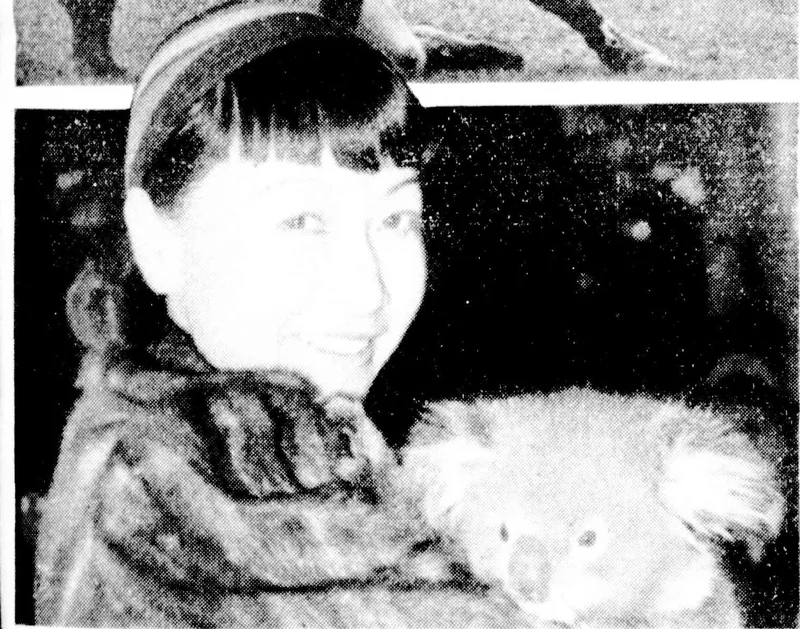
“Miss Anna May Wong found this baby koala a quaint companion when she visited the sanctuary at Healesville yesterday.” Animated by AI from the photograph; the movement is ours, not the archive’s. The Age, 19 June 1939, p. 15 From The Age, 19 June 1939, p. 15, The Argus, 19 June 1939, p. 8 and The Sydney Morning Herald, 18 July 1939, p. 4.
19
Day of 76
Melbourne
Marjorie Lawrence at the Town Hall
In silver fox over a vermilion and gold Chinese gown, she heard the Australian soprano Marjorie Lawrence’s first Melbourne recital. When Lawrence sang “Danny Boy” she whispered to the columnist beside her that her make-up was ruined.
From The Argus, 23 June 1939, p. 15 and The Sun News-Pictorial, 24 June 1939, p. 7.
20
Day of 76
Melbourne
Lunch at the University
Lady Latham, the Chancellor’s wife, gave a luncheon for her in the Union House at the University of Melbourne; Professor G. S. Browne showed her round, and she met students before she left. Seventy-one years later, students at the same university made her shoes.
From The Herald, 23 June 1939, p. 8, The Argus, 24 June 1939, p. 7 and The Sun News-Pictorial, 24 June 1939, p. 10.
28
Day of 76
Melbourne
“At the Barricade”
A new sketch went into her act, “based on an actual incident in the Eastern situation”: the Japanese blockade of the British concession at Tientsin. She played a young Chinese girl defying an enemy general. It was probably the first dramatic sketch by the Tivoli’s gag-writer, Fred Parsons.
From The Argus, 1 July 1939, p. 2, The Sun News-Pictorial, 3 July 1939, p. 12 and The Sun, Sydney, 18 August 1953, p. 20.
35
Day of 76
Flemington
Grand National day
At the Grand National Steeplechase she was the one the social pages wrote down.
“One of the most brilliant figures was the actress Miss Anna May Wong. Her small swathed turban was in a vivid tomato shade, as was her tailored cloth coat.”
From The Age, 10 July 1939, p. 3 and The Australasian, 15 July 1939, p. 20.
43
Day of 76
Melbourne to Sydney
“Never so cold in my life”
The Melbourne season closed on Saturday 15 July, after five weeks. She went to Sydney by the overnight express the next night.
“I have never worn woollies before in my life, but travelling from Melbourne, I not only put on woollies under a thick nightgown, but, with bed jacket and dressing gown over that, still I could not get warm.”
From The Argus, 15 July 1939, p. 30, The Sun, 17 July 1939, p. 3 and The Sun News-Pictorial, 18 July 1939, p. 3.
44
Day of 76
Sydney
Roses at Central
Deputations from the New South Wales Chinese Women’s Relief Fund and the Young Chinese League met her at Central Station. Mrs Mane gave her red roses for the China Women’s Relief Fund Committee, and the crowd cheered. She was asked about the war in China.
“I should like to give my views very much. Unfortunately, however, before I left Hollywood my directors expressly asked me not to discuss politics at all. You see, they sell films in Japan, so their attitude is understandable.”
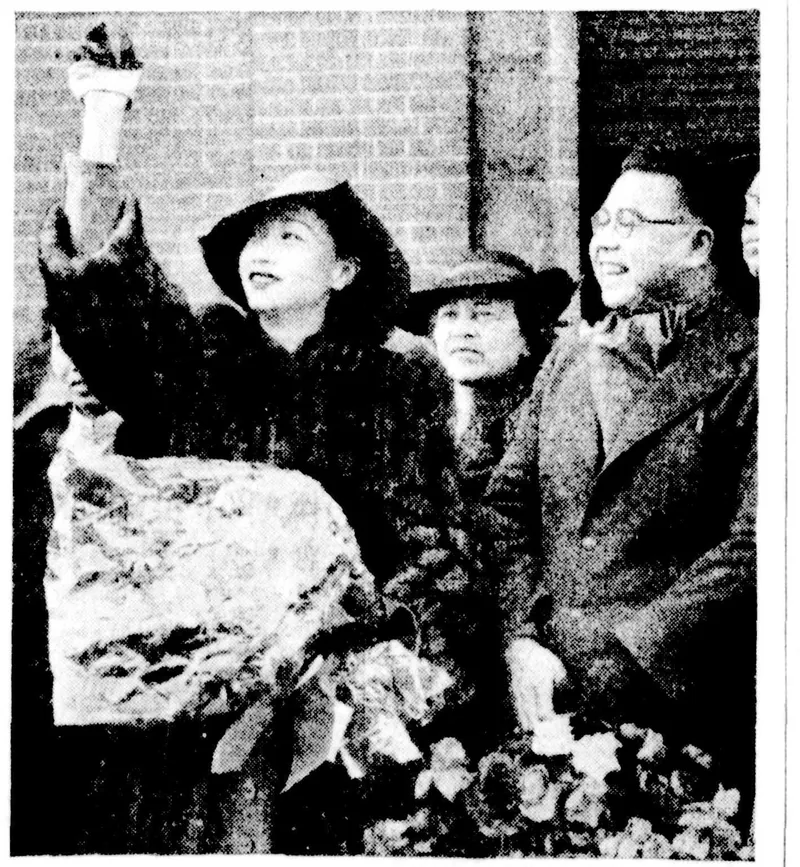
“The Chinese film star, Anna May Wong, arrived in Sydney from Melbourne yesterday and was welcomed by members of the Chinese community. She is shown acknowledging the greetings of the crowd.” The Sydney Morning Herald, 18 July 1939, p. 14 From The Sun, 17 July 1939, p. 3, The Sydney Morning Herald, 18 July 1939, p. 14 and Newcastle Sun, 18 July 1939, p. 7.
44
Day of 76
Sydney
“The wong end of the wace”
To the Herald’s Jack Meander she joked about all the wongs in Australian place names.
“For instance, I’m determined to have my photograph taken going back, back, back, to Yarrawonga. Then again, in Melbourne, I backed a horse called Wongawill in a race. Well, it came in at the wong end of the wace.”
“It’s given me what I sought for two years in the ‘hectivity’ of Hollywood — tranquility and serenity of mind. Having come so far, I see my home in its true perspective.”
From The Sydney Morning Herald, 18 July 1939, p. 4 and The Sydney Morning Herald, 18 July 1939, p. 4.
45
Day of 76
Point Piper
Madame Pao’s dinner
The welcome called off in June: dinner in her honour at the Consul-General’s house at Point Piper, with red candles and camellias, a pailou of sugar, and Chinese silk mats more than a hundred years old.
47
Day of 76
Sydney
Opens at the Sydney Tivoli
The show opened in Sydney on Thursday 20 July, twice a day, to a “vociferous welcome”, with the Paos in a box. Sydney saw “At the Barricade”, and its critics called it propaganda.
“You can take away our people’s eyes so they cannot see — their tongues so they cannot speak. … You can kill me a thousand times, but you’ll never kill the Chinese spirit.”
“The sketch, “At the Barricade,” was frankly anti-Japanese propaganda and gave the actress full scope for her dramatic ability.”
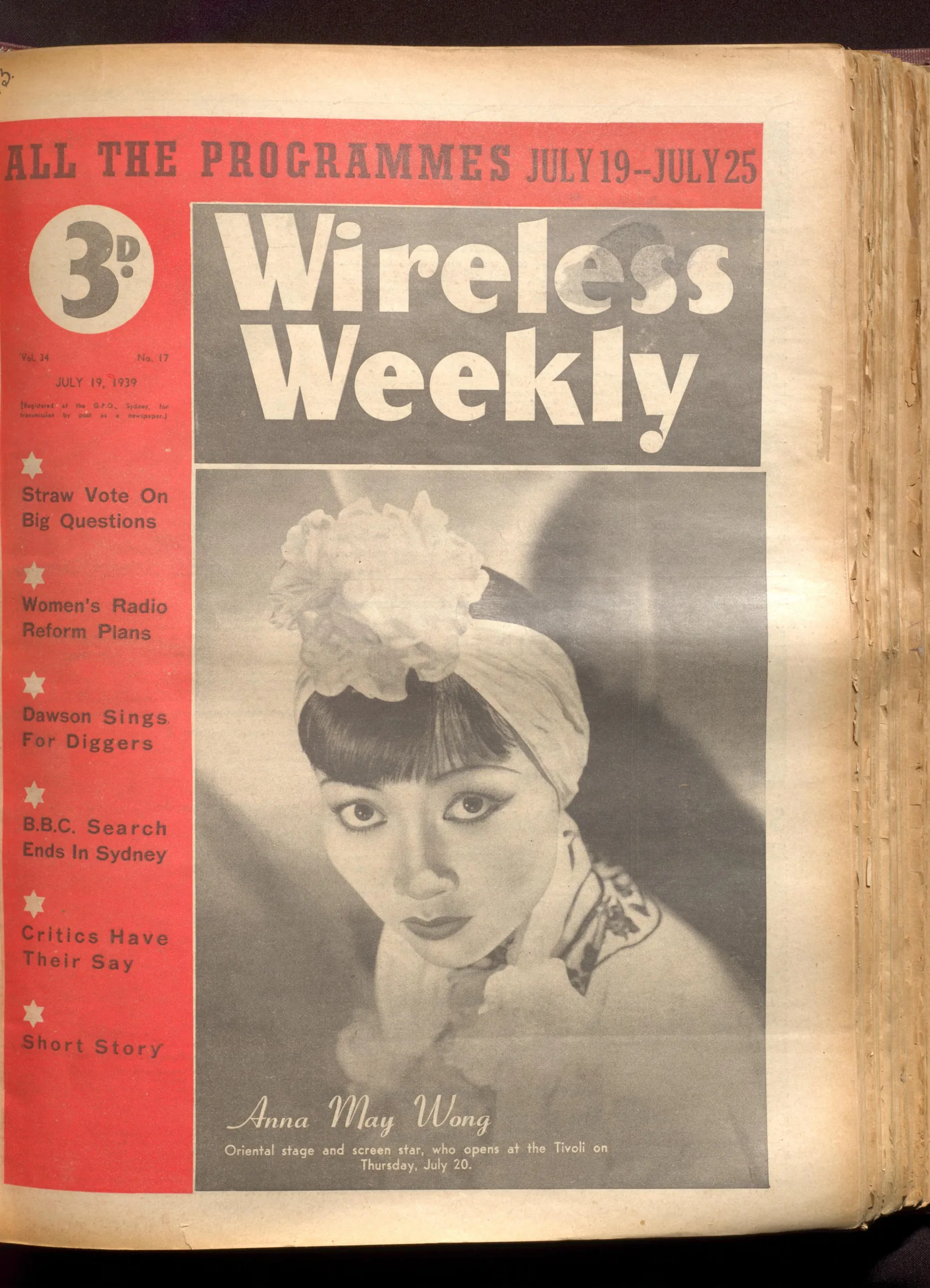
The Wireless Weekly’s cover the day before she opened at the Sydney Tivoli: “Oriental stage and screen star, who opens at the Tivoli on Thursday, July 20.” The Wireless Weekly, 19 July 1939; National Library of Australia From The Sydney Morning Herald, 21 July 1939, p. 13, The Sun, 21 July 1939, p. 6 and Daily News, 21 July 1939, p. 5.
47
Day of 76
Sydney
Act number 13
On opening night she spent forty-five minutes on her make-up. Her act was number 13 on the call sheet; firecrackers and joss sticks sat on her dressing-table.
“Not a bit. After all one and three make four, there are 11 letters in Anna May Wong, and my lucky number is 22, so what?”
48
Day of 76
Sydney
A collie
She had acquired a collie since coming to Sydney, and had him measured for a rug at David Jones’s.
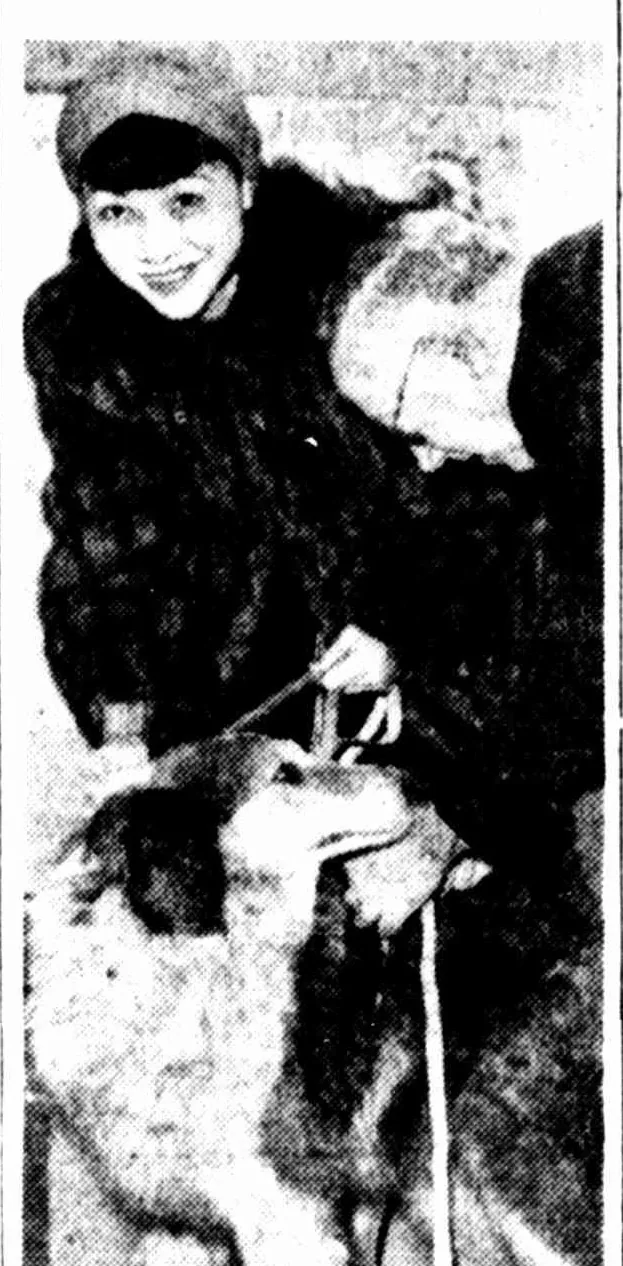
“Anna May Wong, Chinese film star, has acquired a collie dog since coming to Sydney. Yesterday she had him measured for a rug at David Jones’s.” Animated by AI from the photograph; the movement is ours, not the archive’s. The Sun, Sydney, 22 July 1939, p. 3 51
Day of 76
Sydney
“My people are fighting for freedom”
The Daily Telegraph printed an article under her name about the war in China.
“I am not permitted to write on controversial political subjects. It’s in my film contract. But there’s so much to be said of China; so much I feel I must say. My people are fighting for freedom; the freedom to live as they desire — quietly, non-intrusively, and at peace with the world.”
“I am Chinese — all Chinese — and I would not have it otherwise.”
54
Day of 76
Sydney
A buttonhole for Poland
In the morning she met thirty workers of the Young Chinese Relief Movement at the Wentworth to plan a ball in her name. In the afternoon the International Society entertained her with the Consul-General for Poland, Dr L. de Noskowski, and she gave him a buttonhole. Five weeks later Germany invaded Poland.
“I only know one Polish word, and that is ‘I love you,’ but I will say it just the same.”
“If Poland has to fight it will be a matter of life and death, and the fight will be carried on to the last man.”
From The Sydney Morning Herald, 27 July 1939, p. 18 and The Sydney Morning Herald, 28 July 1939, p. 4.
57
Day of 76
Sydney
“Boloney”
Brisbane’s Truth asked about a rumoured romance with an Englishman. Her answer was one word, and then a few more.
“Boloney.”
“If you work, and if you’ve got any ideas of keeping that way, you can’t go on sustained bats in Hollywood — you lose your looks, you lose your youth, you lose your contracts.”
59
Day of 76
Sydney
Three photographers
The August number of The Home printed five portraits of her by the Melbourne photographer Athol Shmith. Max Dupain photographed her for the same magazine, and in July the Sydney photographer John Lee made the portrait he printed two years later.
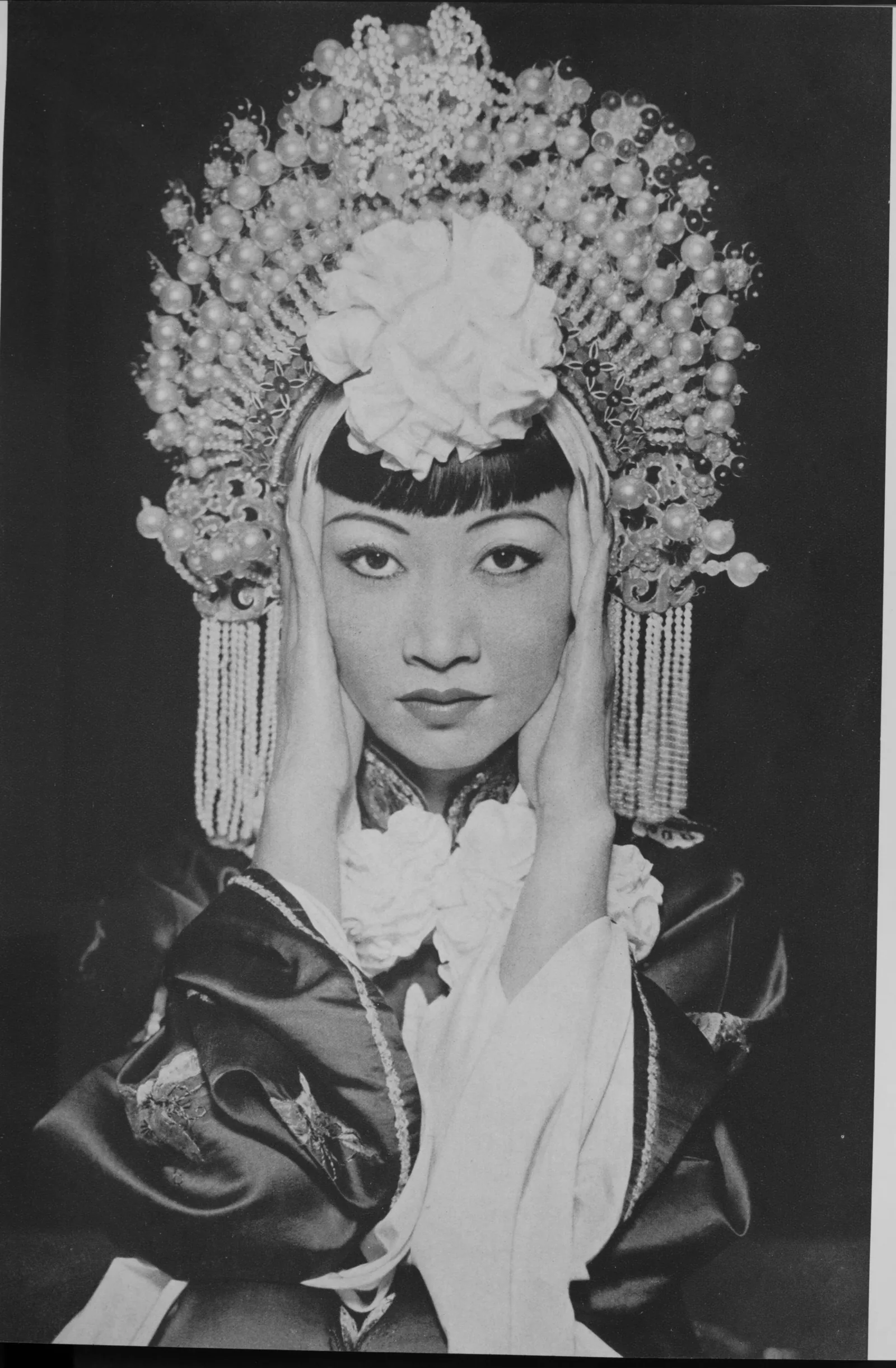
Athol Shmith photographed her in the headdress and robe she wore on stage. The Home printed it, full page, in August. The Home, 1 August 1939, p. 51; National Library of Australia 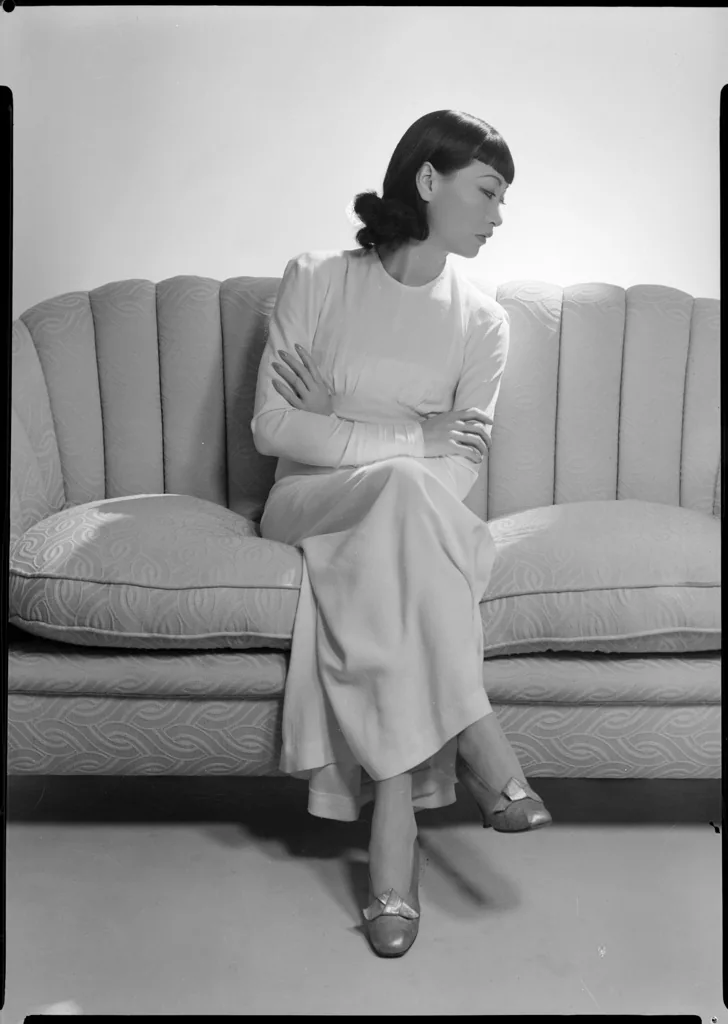
Max Dupain photographed her for the same magazine. Only a small copy of the negative is online. Max Dupain, Mitchell Library, State Library of New South Wales 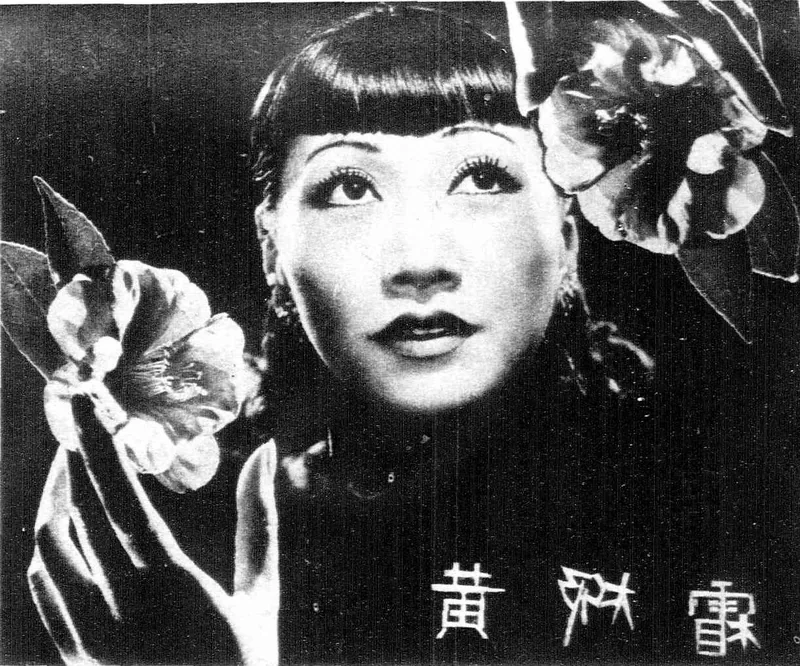
The Sydney photographer John Lee: “I photographed Anna May Wong the last time she was in Australia (July, 1939). Her beautiful hands, willowy figure particularly attracted me.” He printed it in 1941. The Daily Telegraph, 2 November 1941, p. 3 From The Home, 1 August 1939, pp. 50–51, Max Dupain, State Library of New South Wales and The Daily Telegraph, 2 November 1941, p. 3.
63
Day of 76
Sydney
The best meal she ever had
The Australian Women’s Weekly asked famous people for their most memorable meal. Hers was in Shanghai.
“There were 43 courses! … Every sixth course on the menu was soup, as though to encourage us to start the dinner all over again, and not one course were we allowed to miss!”
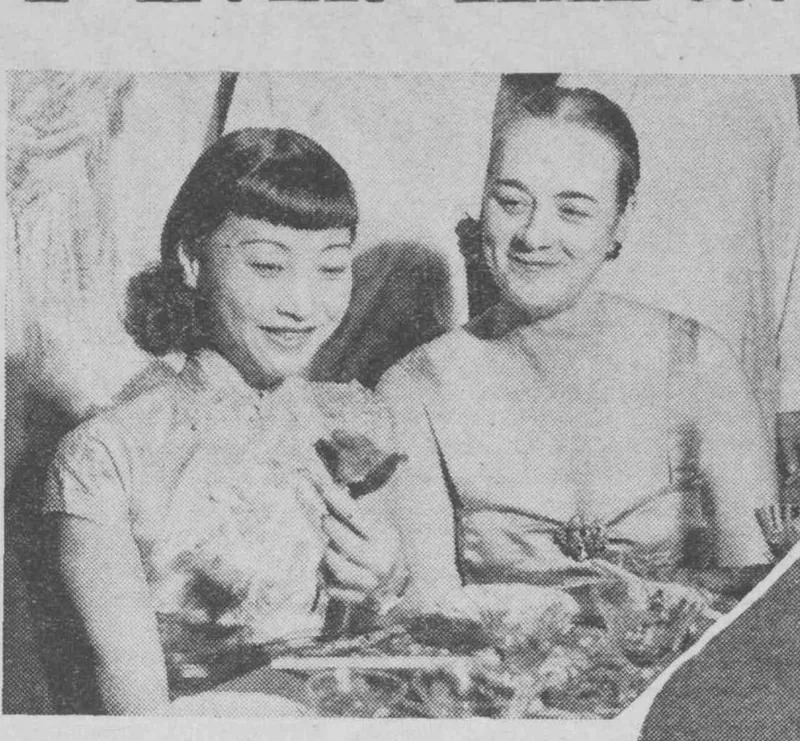
“ANNA MAY WONG, Chinese stage and screen actress, had the perfect meal in Shanghai. There were 43 courses.” The Australian Women’s Weekly, 5 August 1939, p. 20 66
Day of 76
Sydney
The Anna May Wong Ball
After her Tivoli performance she went on to a ball in her name at the Wentworth, given by the Young Chinese Relief Movement for an ambulance unit in China. Her name was spelt out in sweet peas over the official table, guests wore “lucky portrait buttons” of her, and she sold signed photographs. It raised £35 13s 10d.
From The Sun, 9 August 1939, p. 14, The Sydney Morning Herald, 9 August 1939, p. 6 and The Sun, 26 September 1939, p. 9.
72
Day of 76
Sydney
Cabled home
The Tivoli advertised her last four days: a cable had offered her a part in a new film, and Frank Neil had released her five days early. Her last night was a “Gala Farewell” on Thursday 17 August. In her last days she was “out” to every caller, and one night two hundred people waited for her at the stage door in vain.
From The Sydney Morning Herald, 14 August 1939, p. 2, The Sydney Morning Herald, 16 August 1939, p. 7 and The Daily Telegraph, 18 August 1939, p. 2.
76
Day of 76
Sydney
Sails in the Monterey
The Matson liner Monterey sailed at 11 from No. 1A Darling Harbour with Artur Schnabel, Charlotte Greenwood and Adolph Zukor aboard and about five thousand people on the wharf. Her cabin held Australian beer, 150 skeins of wool, rugs, toy koalas, and seeds of waratah, boronia, desert pea and Christmas bush. She signed a boomerang, and sent a message to a meeting to boycott Japanese goods.
“It’s a wonderland for the tourist. I loved the bushland, and the natural beauty of the country made me ache.”
“M-m. This is the goods. I’ve found a lot of grand things in Australia, but this is one of the best. I don’t drink alcohol much, but I’m going to miss this when I get back to America.”
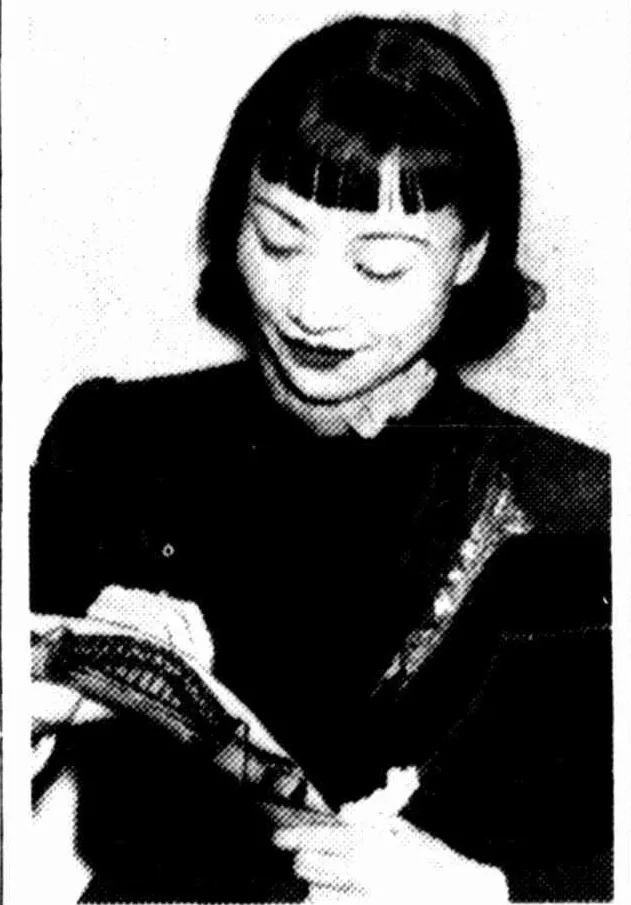
“Anna May Wong, Chinese film star, also sailed by the Monterey. She autographed a boomerang before leaving.” The Sun, Sydney, 18 August 1939, p. 1 From The Sun, 18 August 1939, p. 1, The Daily Telegraph, 19 August 1939, p. 2, The Daily Telegraph, 19 August 1939, p. 2 and The Sydney Morning Herald, 19 August 1939, p. 11.
At sea
At sea, Honolulu
Shore leave granted
The Monterey called at Auckland, Suva and Pago Pago and reached Honolulu on 30 August, where the immigration service stamped her form: “Shore leave granted”.
From US National Archives, case file 14036/236-A and The Sydney Morning Herald, 2 September 1939, p. 22.
Home
Los Angeles
Home, as the war begins
On 3 September Britain, and then Australia, declared war on Germany. Her papers have her readmitted at San Pedro that day: “Readmitted at San Pedro, California. SS President Taft Sept. 3, 1939”, on the receipt she signed for them, though the stamp on her form says the 4th and the papers here had her sailing all the way in the Monterey. The Australian papers record nothing she said about the war in Europe. Her last words here had been about China.
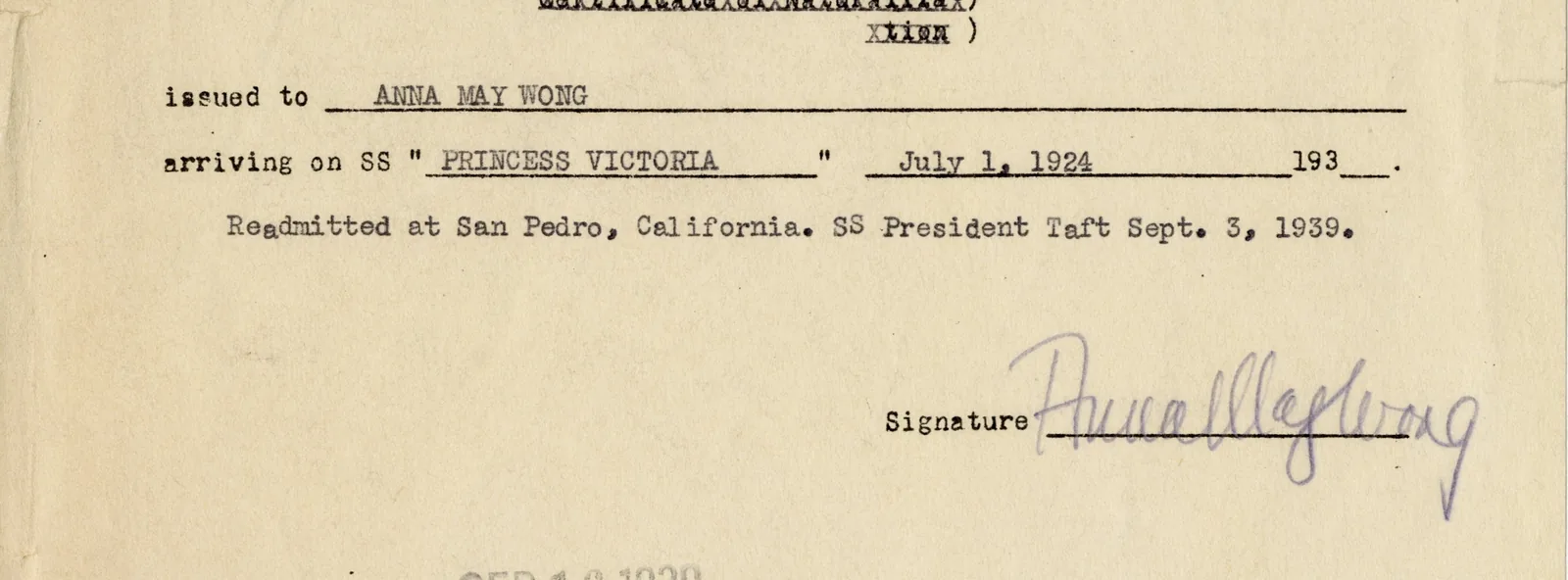
Home: “Readmitted at San Pedro, California. SS President Taft Sept. 3, 1939.” She signed for her papers. US National Archives, case file 14036/236-A From US National Archives, case file 14036/236-A and Daily Commercial News and Shipping List, 4 September 1939, p. 3.
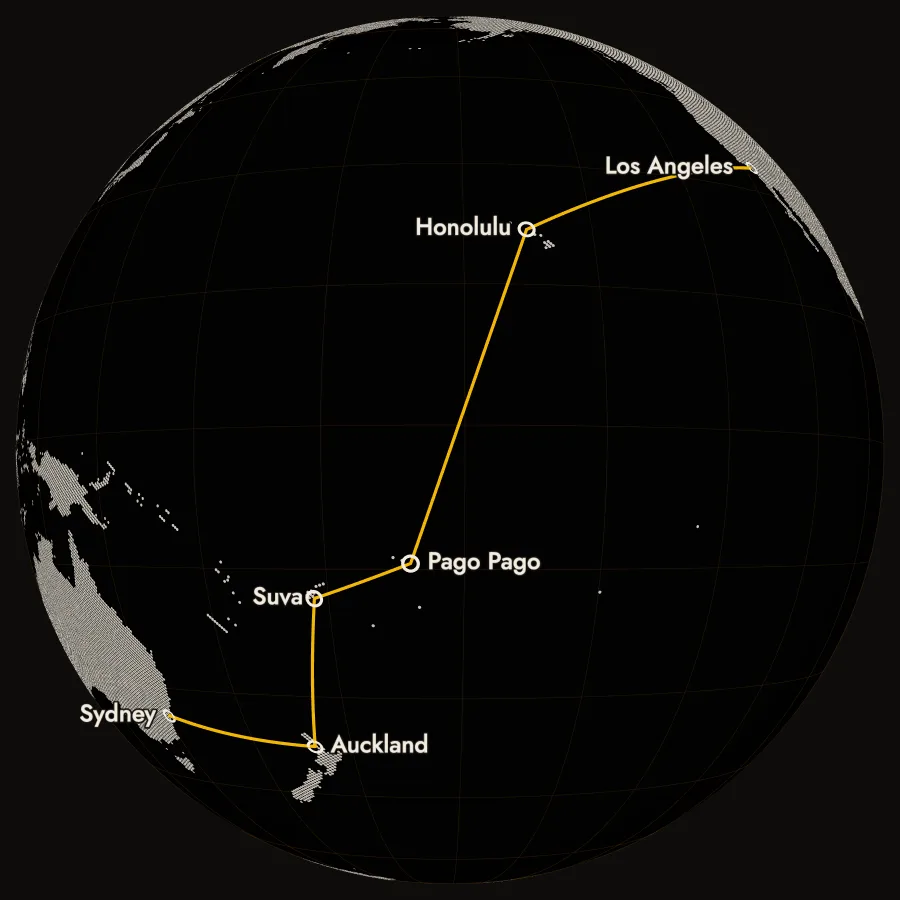
The crossing home
A cable offered her a film, and Frank Neil let her go five days early. She sailed in the Matson liner Monterey on 18 August, by Auckland, Suva, Pago Pago and Honolulu, where she was granted shore leave on 30 August, and was home at Los Angeles as the war began.
- Sydney
- Auckland
- Suva
- Pago Pago
- Honolulu
- Los Angeles
The lucky shoe
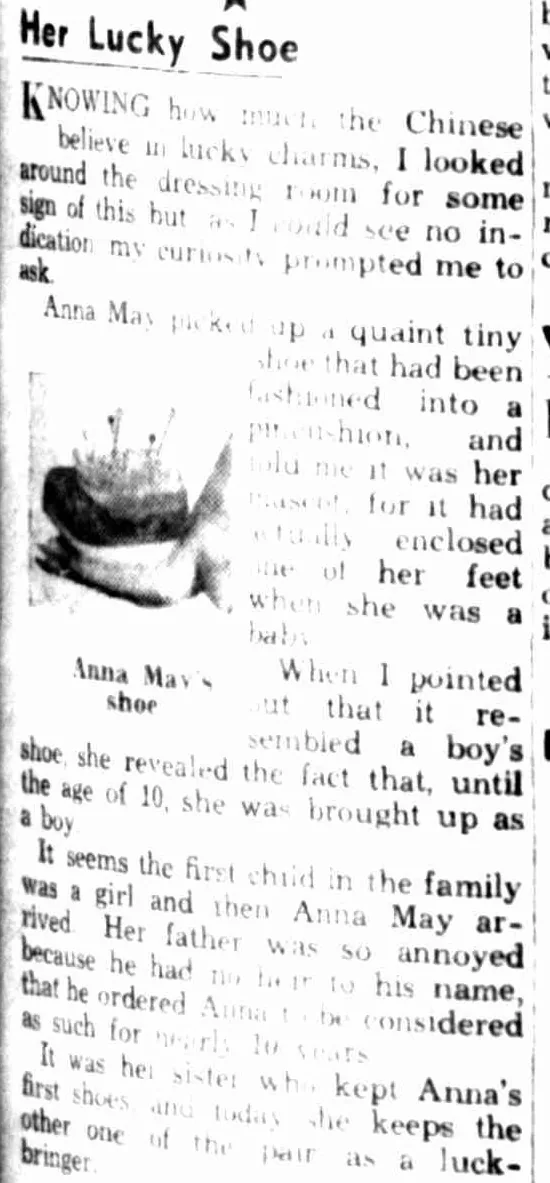
“Anna May picked up a quaint tiny shoe that had been fashioned into a pincushion, and told me it was her mascot, for it had actually enclosed one of her feet when she was a baby.”
It was the morning of Monday 12 June, the last rehearsal before her first matinee at the Tivoli in Bourke Street. Swift had looked round her dressing room for a lucky charm and, seeing none, asked. The shoe looked like a boy’s, he said, and by his account she told him why: her father, whose first child had been a girl, had wanted an heir, and until she was ten she was brought up as a boy. Her sister had kept her first shoes, and she kept one of the pair for luck. That week The Argus photographed her in the shoe department at Foy’s.
Seventy-one years later the lucky shoe became a brief. Derham Groves set his architecture students at the University of Melbourne this: “Create a pair of (lucky?) shoes for Anna May Wong by altering (i.e. cutting, covering, painting, re-building, etc.) an old pair of shoes purchased from an op shop. Don’t hold back!” Fifty-two pairs were handed in on 12 October 2010, each with two hundred words on how it was hers.
The 52 who made her shoes, 2010
- Steve Zhirui Yu
- Muhammad Abid
- Lavanya Arulanandam
- Rubina Barooah
- Christopher Berzins
- Justin Bolton
- Tim Clarke
- Rebecca De Haas
- Kate Fitzgerald
- Neo Fu
- Maria Haenichen
- Ryan Hajeb
- Linton Hart
- Cheryl Siew Wan Heap
- Jasmine Heo
- Yoke Kim Lee
- Zoe Lewis
- Ying Li
- Maggie Ma
- Yindong Ma
- Sarah MacIsaac
- Paul Mak
- Niquita Mascarenhas
- Daniela Melzer
- Katie Miller
- Lachlan Michael
- Sandra Mrowetz
- Scott O’Reilly
- Kim Peeters
- Dylan Fangyin Peng
- Callista Sie
- Ahmad Faaris Suden
- Amanda Pei-er Tan
- Francisca Sugiarto
- Jia Peng Wu
- En Yee Teh
- Joris Van Dijk
- Francis Van Oss
- Lodewijk Vinckier
- Alexandra Wall
- Claire Welsh
- Enjie Wu
- Tracy Xia
- Si Xiong
- David Young
- Nur Zafira Zainal Abidin
- Audrey Zefara
- Bo Zhang
- Yue Zhao
- Jia Yuan Yang
- Will Liheng Xu
- Linna Zheng
The books
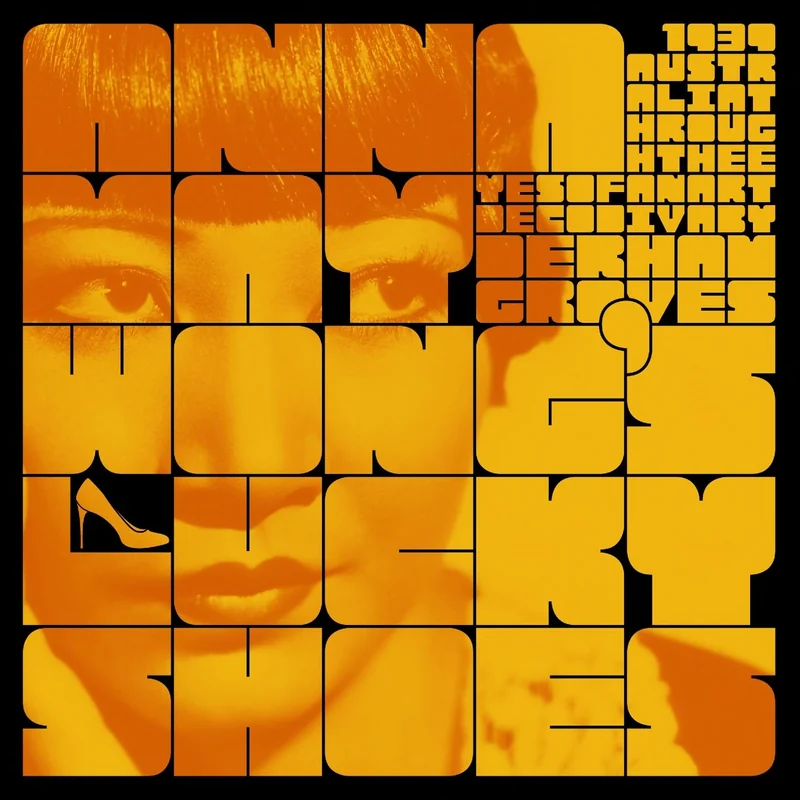
The book of the visit
Anna May Wong’s Lucky Shoes
1939 Australia Through the Eyes of an Art Deco Diva
By Derham Groves, with a foreword by Elaine Mae Woo and photographs by Lee McRae. Cover by Huey Groves.
Derham Groves, an architect and pop-culture historian who teaches at the University of Melbourne, first saw her in a Sherlock Holmes film, A Study in Scarlet (1933), and was smitten. Her biographers say almost nothing about her time here, so he read the Australian papers of 1939 day by day and wrote the first account of the visit, in her own words wherever he could.
The second half of the book is the fifty-two pairs of shoes, every pair photographed by Lee McRae.
- 2011, Culicidae Press
- The first edition, printed by Lulu; AU$39.95 when it came out. ISBN 978-1-257-71315-8.
- 2013, Culicidae Press
- 104 pages, 21.6 cm square, in full colour. The edition in print. ISBN 978-0-615-86068-8.
“What could be better than a mystery? Or a beautiful, mysterious femme fatale in shoes that Jimmy Choo might well envy! And the whole package in residence in far off Australia, where stardom finally blooms!”
“Groves does not turn away from objects or art nor use either as a platform to illustrate a set of ideas … rather, for Groves, it is art that matters.”
More to read
The lives of her, and what each says of Australia.
Anna May Wong: From Laundryman’s Daughter to Hollywood Legend
Graham Russell Gao Hodges, 2004
The standard life (new editions 2012 and 2023). It says little of the visit and has her land in Melbourne; she landed in Sydney.
Daughter of the Dragon: Anna May Wong’s Rendezvous with American History
Yunte Huang, 2023
The fullest American account of the visit, at the Tivoli “two shows per day, six days per week”.
Perpetually Cool: The Many Lives of Anna May Wong
Anthony B. Chan, 2003
Says she gave her Australian earnings to China war relief. Derham Groves doubts it: no Australian paper said so.
Anna May Wong: A Complete Guide to Her Film, Stage, Radio and Television Work
Philip Leibfried and Chei Mi Lane, 2003
Every film, play and broadcast, with the Melbourne Tivoli programme reproduced.
Anna May Wong: Performing the Modern
Shirley Jennifer Lim, 2019
Her stardom as modernity; Lim was one of the voices on ABC Radio National’s Hindsight in 2013.
Not Your China Doll: The Wild and Shimmering Life of Anna May Wong
Katie Gee Salisbury, 2024
The newest life.
Tivoli
Frank Van Straten, 2003
The history of the circuit that brought her here, and of Frank Neil, who ran it.
Australia and Anna May Wong
From her first notice in an Australian paper, in 1921, to now.
- 1921Her first notice in an Australian paper: Dinty at the Majestic, Brisbane, with “Anna May Wong, a beautiful Chinese maiden of 18 summers, in pretty Oriental garb”. She was sixteen. Brisbane Courier, 16 April 1921
- 1924The Toll of the Sea opens at the Strand in Sydney, in colour: “Anna Mae Wong, the little Chinese girl doing a very remarkable piece of acting.” Truth, Sydney, 6 January 1924
- 1929In London she plays The Circle of Chalk with the Melbourne-born actress Rose Quong, who, Melbourne’s Herald reports, “has received more notice from the critics … than even Miss Anna May Wong”. Quong: “the accent came from Melbourne, Australia!” Herald, 30 April 1929, Australian Dictionary of Biography
- 1929The British censor forbids her leading man to kiss her in The Flame of Love, and the ban runs in dozens of Australian papers into 1930. Herald, 11 November 1929
- 1932A draper in Portland, Victoria, sells “Anna May Wong” shoes: “For the beach or sports wear … they are the last word in smartness.” Portland Guardian, 12 December 1932
- 1934Frank Neil of the Tivoli engages her for Melbourne’s Centenary season. She cables that she is “looking forward with joy to seeing Australia”, and is due to sail in February 1935. She never comes. Herald, 27 July 1934, Herald, 27 October 1934
- 1929–37Australians in her films: Sydney-born Cyril Ritchard in Piccadilly (1929); Chu Chin Chow (1934), the musical by Geelong-born Oscar Asche; Melbourne-born Mae Busch in Daughter of Shanghai (1937). Australian Dictionary of Biography: Ritchard
- 1937The Sydney Morning Herald describes her good-luck charm: a Chinese coin, given her as a little girl, worn on a concealed gold chain. The Sydney Morning Herald, 7 December 1937
- 1939Her one visit, 4 June to 18 August: the Tivoli in Melbourne and Sydney.
- 1940Frank Neil, who brought her here, is knocked down by a car in South Melbourne on New Year’s Eve and dies the next day. Te Pana’s tribute names her first among the stars he brought out. The Courier-Mail, 2 January 1940
- 1941At the Anzac War Relief Fund’s first party in Hollywood she spends the afternoon selling her autographed pictures: “only too delighted to help the Anzacs”. The Australian Women’s Weekly, 11 October 1941
- 1942A 150-year-old mandarin coat she gave Sydney’s Chinese community is paraded at the Dragon Festival Ball for Chinese relief. The Sun, Sydney, 19 June 1942
- 1961Adelaide’s Chronicle reports her death: she “died on Friday night at her home of an apparent heart attack … completed work in a television show only two days before”. Chronicle, 9 February 1961
- 2009ACMI in Melbourne screens a season of her films, with the Australian premiere of Elaine Mae Woo’s documentary Frosted Yellow Willows; Woo and Derham Groves talk about her at the Chinese Museum. Derham Groves, 30 August 2009
- 2010Fifty-two University of Melbourne architecture students make her a pair of lucky shoes each. Derham Groves, 13 October 2010
- 2011Anna May Wong’s Lucky Shoes, the first account of her visit.
- 2013ABC Radio National’s Hindsight: “Oriental stardust: Anna May Wong in White Australia”, with Derham Groves among the guests. ABC Radio National
- 2019The National Film and Sound Archive acquires Fox Movietone’s film of her arrival in Sydney in 1939. NFSA
- 2025The Chinese Museum in Melbourne holds “Glimpses of Anna May Wong in Australia”, with newsreels and the actor Fiona Choi. Chinese Museum
Sources
Everything above was read on 2 October 2026. Where the newspapers and the books disagree, the page says so.
- Trove: the Australian papers of 1939, digitised by the National Library of Australia
- US National Archives: her Chinese Exclusion Act case file 14036/239
- US National Archives: case file 14036/236-A
- State Library of New South Wales: Sam Hood’s photograph
- State Library of New South Wales: Max Dupain’s negatives
- National Library of Australia: The Home, 1 August 1939
- National Library of Australia: The Wireless Weekly, 19 July 1939
- Library of Congress: Carl Van Vechten’s portrait of 25 April 1939
- National Film and Sound Archive: Fox Movietone’s film of her arrival
- The Toll of the Sea (1922), UCLA’s restoration, at the Internet Archive
- Anna May Wong’s Lucky Shoes: the publisher’s preview, with the book’s endnotes
- Australian Dictionary of Biography: Rose Quong
- Natural Earth: the coastlines on the globe
Where the sources disagree
- How long she stayed. Anna May Wong’s Lucky Shoes counts 107 days, which is 4 June to 18 September. The papers put her ashore from Sunday 4 June to Friday 18 August 1939: 76 days. She was away from Los Angeles from 4 May to 3 September.
- How she went. The book has her sail for Honolulu from San Francisco, most likely in the Lurline; her sworn statement and the stamp on her form say San Pedro and the Matsonia, on 4 May.
- How she came home. The book, Yunte Huang and the Sydney papers have her sail in the Monterey; her immigration receipt says she was readmitted from the President Taft on 3 September, and the stamp on her form says the 4th.
- Where she showed the lucky shoe. The book’s back cover says Sydney; Jonathan Swift’s column puts it in her dressing room at the Melbourne Tivoli on the morning she opened, 12 June.
- When she died. The book gives Thursday 2 February 1961. The Los Angeles papers, her biographers and Adelaide’s Chronicle all say Friday 3 February.
- Where she landed. Graham Russell Gao Hodges has her arrive in Melbourne; she landed in Sydney and went on to Melbourne by train.
- Her earnings. Anthony B. Chan says she gave her Australian earnings to China war relief. No Australian paper said so; the ball in her name raised £35 13s 10d for an ambulance unit.